A Collector's Guide
Stop Blaming China
The True Culprits Behind the High-End Lightsaber Market Crisis
Last updated: 26 Apr 2026
Introduction
A pervasive narrative within the custom lightsaber community asserts that "China is at fault for flooding the USA and the world with cheap bulky lightsabers, and killing off the high-end lightsaber artisans." However, a comprehensive review of the detailed chronicles provided by The Exiled Jedi reveals that this claim is fundamentally flawed. The evidence demonstrates that the decline of high-end artisans and the broader crisis in the custom lightsaber industry are self-inflicted wounds driven by structural market failures, a toxic and heavily conflicted community, and the fragile business models of Western makers themselves.
The Illusion of the "Non-China" Artisan
The argument that Chinese manufacturing is destroying pure Western artisanship relies on a false dichotomy. The reality is that the global lightsaber supply chain is deeply intertwined, and the distinction between "Chinese" and "Non-Chinese" hilts is often a marketing fiction.
Many prominent Western brands and highly respected installers operate within this blurred line. For instance, Korbanth, a prominent US-based seller, frequently sources its popular replica hilts directly from 89Sabers, a premium Chinese manufacturer. Similarly, UK-based KR Sabers lists hilts from Chinese makers such as ELFsabers and 89Sabers. Furthermore, companies like Crimson Dawn, Padawan Outpost, and Imperial Workshop are fundamentally resellers for the Chinese mass-market titan LGT Sabers.
The Dropshipping Trap: A Margin Crisis of Their Own Making
A frequent defense of Western makers is that moving from manufacturing to dropshipping provides margins too slim to survive. This argument entirely misses the point: the pivot to dropshipping is a symptom of business failure, not the cause.
When brands like Vader's Vault — once the undisputed pinnacle of the American lightsaber market — largely transition to operating as dropshippers, they are voluntarily surrendering their artisan identity to compete on volume and logistics. The slim margins of dropshipping are an inevitable economic reality of white-labeling mass-produced Chinese goods (such as those from LGT or TXQ). Western companies cannot out-compete Chinese factories on economies of scale or supply chain efficiency.
Self-Inflicted Wounds: The Fragility of Western Business Models
The closure of several prominent Western artisans cannot be solely attributed to Chinese competition. Instead, these failures highlight a "classic failure cycle" endemic to the niche, hype-driven lightsaber business.
- The shutdown of The Custom Saber Shop (TCSS) in April 2026 was attributed to the industry "slowing down quite a bit over the last few years," rather than a direct assault by Chinese manufacturers.
- Genesis Custom Sabers closed after 15 years because its founder simply "fell out of love" with the hobby, signaling personal and market fatigue.
- The Saber Workshop shuttered due to external economic pressures — shipping costs had tripled and tariffs had doubled, evaporating their margins. A macroeconomic and trade policy issue, not a competitive one.
The Toxic Community and Structural Market Failure
The most significant factor strangling the custom lightsaber market is a profound trust deficit cultivated by a toxic, insular community. The industry operates as a textbook "market for lemons," where information asymmetry and the inability of buyers to verify quality drive out honest vendors and shrink the market.
Conflicts of Interest and Censorship
The primary hubs for buying, selling, and reviewing sabers are large Facebook groups managed by individuals with direct financial stakes in the market. Groups like "The Vault" and "Lightsaber Market" are moderated by co-owners of major brands such as Vader's Vault and 89Sabers — the "fox built the henhouse, staffed it, and wrote the rules."
In these echo chambers, negative reviews are swiftly deleted, and legitimate grievances are met with coordinated hostility from the vendor's loyal followers. When buyers attempt to share negative experiences, they face censorship and shadow-banning, actively discouraging consumer protection.
The Trap of Punishing Lead Times
Western artisans often demand premium prices ($400 to $1,300+) while subjecting customers to punishing lead times ranging from 8 weeks to over 6 months, and sometimes stretching to 2–5 years. The community actively normalizes these delays. Consequently, buyers are pressured into letting their 180-day PayPal or credit card dispute windows expire, leaving them entirely at the mercy of sellers who may be experiencing cash flow desperation or operational collapse.
Feedback from the community: Is China to Blame?
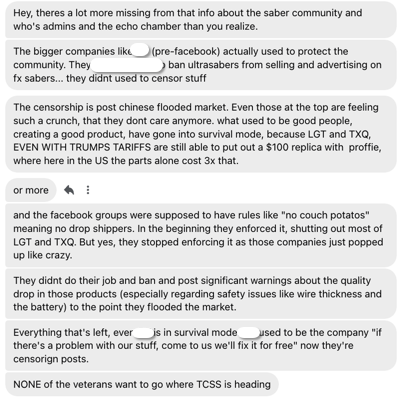
The True Bad Actors Are Often Western
The narrative that China is flooding the market with inferior products ignores the staggering misconduct of prominent American companies. UltraSabers, based in Texas, holds a Trustpilot record where 74% of its 297 reviews are one-star. Customers consistently report defective products, refused refunds, punitive restocking fees, and ignored warranty claims, alongside exposed practices of paying for fake positive reviews.
Similarly, DX Sabers in Pennsylvania has built a business model around convention hustles and online fulfillment fraud. With 33% of its 781 Trustpilot reviews being one-star, customers have reported fake tracking numbers, fictional employees, and thousands of dollars in stolen property, leading to the creation of a 445-member Facebook group dedicated solely to exposing the company's fraudulent practices. These domestic actors have done far more to damage consumer trust than any foreign manufacturer.
And despite these horrible commercial practices perpetuated by companies like the above, unenlightened people wowed by the marketing are still buying from them! This only underscores how strong the market is, or can be — provided lightsaber companies get their act together, soon: standards, consumer protections, payment security, independent reviews, authentication.
How High-End Artisans Can Survive: The "Quartz Crisis" Blueprint
As this is written, there ARE companies that are surviving — hilt makers like Jawa Junkyards, TierfonOrbital, KR Sabers, and installers like Protosabers and TierfonOrbital. To survive IS possible, but requires avoidance of the Classic Failure Cycle in this niche, hype-driven business:
The custom lightsaber industry is not shrinking because of China; it is failing to grow because it actively repels the very demographic that could sustain it. The global toy market is booming, fueled by "kidulting" — adults who spent over $1.5 billion on toys in the final quarter of 2024 alone, with Star Wars merchandise exceeding $1.5 billion annually in the US. Disney successfully sells 10 million lightsabers a year, proving the demand exists.
To survive the influx of cheap, mass-produced Chinese hilts, high-end lightsaber artisans must look to history — specifically, how the Swiss mechanical watch industry survived the "Quartz Crisis" of the 1970s and 1980s. When cheap, highly accurate quartz watches from Japan flooded the global market, Swiss watchmakers realized they could no longer compete on pure utility or price. Instead, they survived by completely reframing their value proposition.
Lightsaber artisans must adopt a similar strategy to thrive:
Conclusion
The data and case studies presented by The Exiled Jedi demonstrate unequivocally that the crisis in the high-end lightsaber market is not a story of Chinese predation. It is a story of Western companies abandoning their craft to chase dropshipping margins, of toxic Facebook ecosystems that silence consumers and protect fraudsters, and of one-man operations taking on more than they could ever sustainably deliver.
This is my journey — read it, learn from it, and navigate this wild ride with open eyes.