A Collector's Chronicle
The Great Divide
China vs. Non-China in the Lightsaber Hilt Market
By Shing
Last updated: 12 Jul 2026
The journey from owning zero lightsabers on January 1, 2025, to amassing a collection of over 110 high-end pieces by January 1, 2026, has been nothing short of tumultuous. As a collector who has navigated the murky waters of predatory flippers, outright scammers, and masterclass manipulators of online narratives, the reality of the high-end lightsaber market is far more complex than the shiny marketing suggests.
Feedback from the community: Is China to Blame?
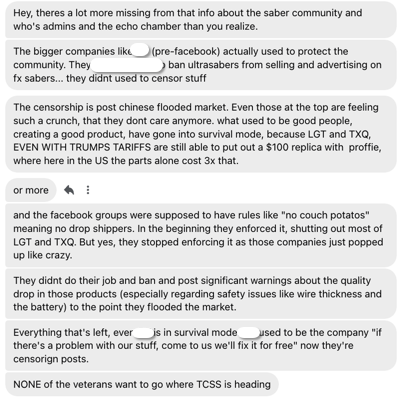
Unsolicited Facebook Messenger Msg from lightsaber community member — 11 April 2026
The Illusion of Origin
The Blurred Supply Chain
The reality is that a significant portion of the global lightsaber supply chain runs directly through China. Massive manufacturers like LGT Sabers, TXQ Sabers, and DamienSaber operate on an OEM or white-label model, allowing dozens of Western companies to rebrand and sell them as their own. Companies such as Crimson Dawn, Padawan Outpost, and Imperial Workshop are fundamentally LGT resellers, operating within an ecosystem where the Chinese manufacturers prioritize volume over brand exclusivity.
Many non-Chinese makers also work with Chinese hilt manufacturers to custom design and order short run productions of their own design, typically with a Minimum Order Quantity (MOQ) of about 100-150 pieces per run.
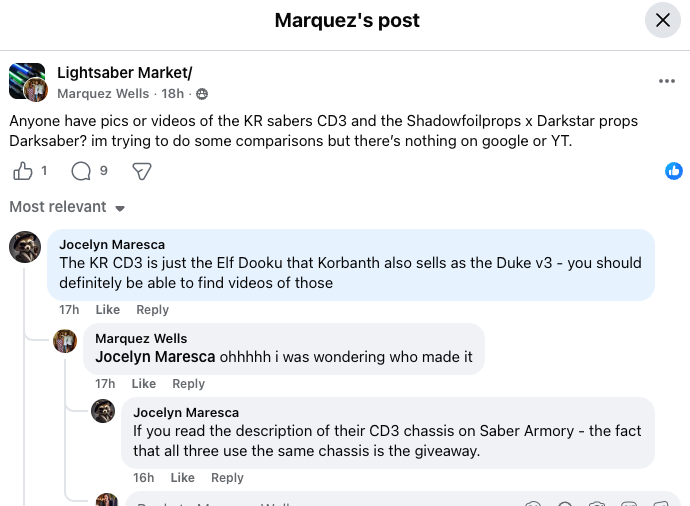
A telling exchange in the Lightsaber Market Facebook Group (11 Jun 2026): a community member asks about the KR CD3 and is quickly informed it is the same hilt as the Elf Dooku — also sold by Korbanth as the Duke v3. Three different brand names, one Chinese-manufactured hilt. The chassis listed on Saber Armory confirms the connection. This is the blurred supply chain in action.
Even highly respected non-Chinese installers operate within this blurred line. For example, both KRsabers and Korbanth, prominent UK- and US-based sellers, offer premium empty hilt kits and installed sabers. However, Korbanth is primarily a curator and installer; many of their most popular replica hilts are sourced directly from 89Sabers, a premium Chinese manufacturer. KRsabers too list hilts from ELFsabers and 89sabers. The distinction in the market often comes down not to where the hilt was machined, but who designed it, who installed the electronics, and who provides the customer service.
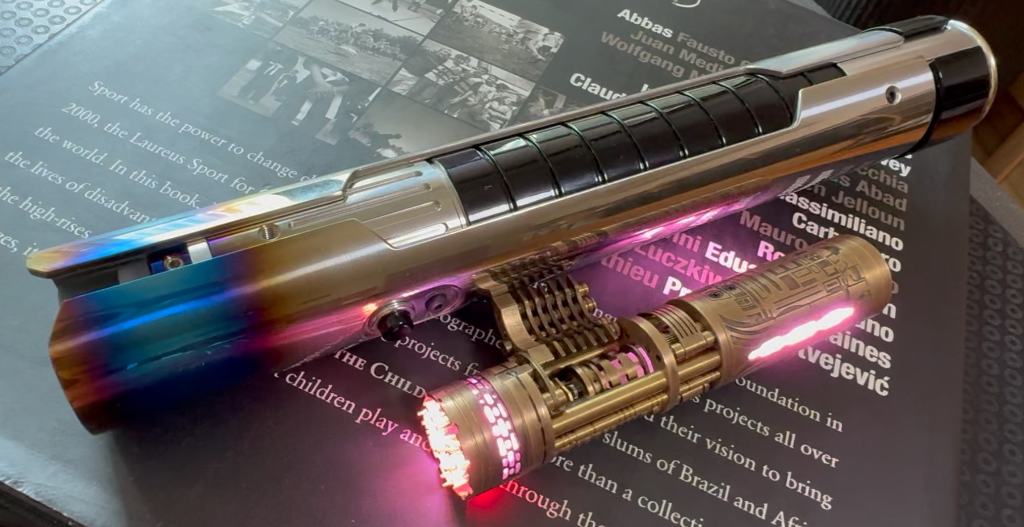

The PunkSabers SOL hilt with a LGT Interchangeable brass chassis with spinning crystal, costing USD 96.51 + USD 117.52 respectively, and to me one of the best made and correctly sized (afterall, SOL was meant to be a big hilt) China-made sabers.
The Chinese Market
Scale, Value, and Purchasing Channels
The Chinese lightsaber manufacturing sector is not a monolith. It spans from ultra-budget mass producers to high-end replica artisans, leveraging massive economies of scale that Western machine shops simply cannot match.
Purchasing Channels and Pre-Installed Realities
Almost all Chinese-manufactured hilts come pre-installed. These mass-market hilts are frequently equipped with more basic electronics, such as Xenopixel V2/V3 (LGT) & SNV4 (TXQ) boards or primitive RGB setups, prioritizing ease of use and affordability over deep customization.
When acquiring these Chinese-manufactured hilts, the purchasing channel dictates the experience:
- Taobao (taobao.com): The cheapest option, but requires Mandarin proficiency and a Taobao-recognized payment method.
- AliExpress: Official shops run by manufacturers or dropshippers; slightly higher prices with more Western-friendly purchasing.
- USA/Canada/UK/Europe Dropshippers: Most convenient but often slower, with communication delays and potential cash capital issues.
The Mass Market Titans: LGT and TXQ
LGT Sabers is the undisputed volume leader, democratizing neopixel technology by offering genuine pixel blades and smooth-swing soundboards for under $150. Their business model relies on fixed electronics installations across over 100 hilt designs, constructed from 6061 aerospace aluminum alloy.
TXQ Sabers differentiated itself by introducing a modular core system. By creating their own SNV4 soundboard and standardizing around the open-source Proffie V2.2 soundboard and allowing users to swap electronics cores between hilts, TXQ appealed to long-term collectors seeking future-proof investments.
The Premium Chinese Tier: 89Sabers and the IP Dilemma
Operating on an entirely different philosophy is 89Sabers. Unlike the mass-market brands, 89Sabers positions itself as a producer of museum-grade replicas, with designs based on 1:1 digital scans of film props, utilizing all-metal construction (including stainless steel and brass) rather than just aluminum.
In 2021, prominent independent maker Anakin Starkiller publicly accused 89Sabers of recasting his Luke ROTJ hero saber designs. Similar accusations have surfaced regarding designs originally created by UK-based KR Sabers and independent designer SlothFurnace.
The Non-China Market
Artisans, Installers, and the Struggle to Survive
Contrasting the Chinese manufacturing juggernaut is the non-China market, primarily concentrated in the United States, with notable exceptions in Canada, Australia, and the UK. This sector is characterized by smaller production runs, higher prices, and a mix of genuine in-house manufacturing and high-end installation services.
The Art of the Install
A crucial distinction in the non-China market is that hilt manufacturing and electronics installation are often two completely separate processes and crafts. Unlike the plug-and-play Chinese market, many Western artisans (like Roman Props) sell "empty" hilts—beautifully machined metal shells with no electronics inside.
To bring these hilts to life, collectors must commission a specialized "installer." These installers design and 3D-print custom internal chassis to hold the electronics securely. They meticulously wire high-end, open-source soundboards like the Proffieboard or Crystal Focus X (CFX), which offer infinitely programmable blade effects and smooth-swing algorithms far superior to basic Xenopixel V2/V3 (LGT) & SNV4 (TXQ) or RGB boards. This bespoke installation process is an art form unto itself, often adding hundreds of dollars and several weeks or months to the final cost and wait time of the saber.
The American Premium Market
Vader's Vault, based in Cumming, Georgia, was once the undisputed pinnacle of the American lightsaber market. However, they are best recharacterized today as a yesteryear darling. Their production and manpower numbers have fallen drastically. While they still execute some short custom runs, they now also largely operate as a dropshipper.
The true spirit of the Western market is now carried by makers inclined towards two extremes:
- Screen Accuracy Obsessives: Roman Props, Anakin Starkiller, SaberZ, KRsabers, and 7Chambers pursue absolute accuracy and screen-perfect replicas.
- Creative Artisans: Jawa Junkyards, Ignition Sabers, TierfonOrbital, SpaceJunkSabers and others birth imaginative, wildly interpretational designs that marry Star Wars reality to unbounded weaponry and civilization concepts.
The International Standouts
Sabertrio, based in Malaysia, has cultivated a fiercely loyal following by offering premium quality, highly durable sabers with unparalleled customer service. While their hilt variety is limited, their execution is flawless, proving that Asian manufacturing outside of China can rival American premium brands.
In the UK, KR Sabers is renowned for designing and engineering heavy, premium custom sabers utilizing a Modular Hilt System (MHS) and are considered among the most accurate hilt makers globally—though their designs are frequently the target of Chinese counterfeiters (they also procure hilts from Chinese makers).
Jawa Junkyards, an Australian saber maker, is noteworthy for its consistency and highly-inventive designed products.
BUT NEVER FORGET: Any Business Can Be Subject To The Classic Failure Cycle
In this niche, hype-driven business, companies frequently fall victim to a predictable failure cycle:
- Unsustainable Scaling: Riding a hype bubble without building sustainable capacity.
- Financial Irresponsibility: Taking more money than the operation can responsibly fulfil.
- Cash Flow Desperation: Prioritizing new revenue over fulfilling old obligations.
- Operational Collapse: Shortcutting quality to push products out while staff burn out.
- Running Out the Clock: Relying on payment-platform time limits to expire.
- Damage Control: Managing narratives instead of fixing problems.
Comparing the Markets
A Collector's Decision Matrix
The decision between a Chinese and non-Chinese hilt ultimately depends on the collector's priorities. The following table breaks down the core differences based on current market realities.
| Feature | Chinese (LGT, TXQ, 89Sabers) | Non-Chinese (Roman Props, Sabertrio, KR Sabers) |
|---|---|---|
| Price Range | $79 - $550+ Exceptional value per dollar | $400 - $1,300+ Premium investment |
| Manufacturing | Mass-produced CNC; OEM white-labeling | Smaller batches; mix of in-house CNC and curated sourcing |
| Lead Times | Immediate to 4 weeks Often ships very quickly | 8 weeks to 6+ months Custom builds, high risk of delays |
| Design Variety | Massive catalog (100+ designs); rapid iteration | Highly curated; extreme screen accuracy or wild creativity |
| IP Ethics | Frequent accusations of design theft | Strong respect for independent designer IP (but ultimately all unlicensed & in breach of Disney's IP rights) |
| Customer Service | Highly variable; dropshippers face communication/capital issues | Generally excellent; vulnerable to business failure cycle |
| Community Status | Entry-level to mid-tier (89Sabers as exception) | Prestige pieces and "grail" sabers |
Navigating the Egocentric Culture
As noted in the project chronicle The Toxic Community, the lightsaber community is a tight-knit culture often marred by egocentricity and hostility. Any negative feedback regarding a beloved brand—whether it be pointing out the IP theft of a Chinese manufacturer or the excruciating wait times and communication failures of an American premium maker—is swiftly met with hostility from loyal posses of "couch observers."
For the serious collector, navigating this landscape requires open eyes. It requires understanding that the $600 saber bought from an American website might have been machined in Shenzhen, and that the $300 saber from AliExpress might contain stolen geometry from a hardworking independent artist. It is a wild ride of beautiful products and opaque design origin, grey-market IP ethics and enforcement, semi- or outright crooked sellers, and the only defense is an unfiltered understanding of the supply chain that the market desperately wants to keep hidden.
For additional context on market dysfunction, see: The Toxic Community and An Industry Already in Crisis.