The Toxic Community
The Structural Dysfunction of the Lightsaber Community
A Case Study in Conflict of Interest, Censorship, and Fragmented Information
Last updated: 23 Aug 2026
The custom lightsaber community has developed structural vulnerabilities that leave consumers exposed to significant financial and emotional harm. Over the past twelve months, the full spectrum of dysfunction has been on display: falling and failing sales, terrible resale prices, predatory flippers, outright scammers, sellers who ship $500 hilts without basic bubble wrap, and major "brands" that are little more than sophisticated con artists. While Disney sells 10M lightsabers (China-made) annually, this high-end lightsaber segment struggles to sell 800-1000 per year.
In a healthy marketplace, consumer feedback and transparent communication act as self-correcting mechanisms. In the lightsaber community, those mechanisms have been systematically dismantled. This dysfunction is driven by three core structural failures:
1. Conflicts of Interest: The people who control the flow of information are the same people who profit from the market.
2. Information Fragmentation: Knowledge is shallow, fast-changing, and scattered across platforms, making it impossible for buyers to make informed decisions.
3. Censorship and Hostility: Dissent is punished more harshly than fraud, and consumer protection is actively discouraged by industry insiders.
I. The Fox Guarding the Henhouse
The most significant structural flaw in the lightsaber community is the overlap between group administrators and market vendors. The largest Facebook groups — the primary hubs for buying, selling, and reviewing sabers — are managed and moderated by individuals with direct financial "skin in the game": hilt makers, installers, and resellers.
This is not incidental; it is the defining feature of the marketplace. When an administrator of a major lightsaber group is also a vendor, their moderation decisions are inherently compromised. The fox is not merely watching the henhouse; the fox built the henhouse, staffed it, and wrote the rules.
Who Runs the Largest Groups?
Why is this important? Because Facebook's algorithm will automatically suggest the largest groups to lightsaber newbies. A review of the admin and moderator lists for the community's most prominent Facebook groups reveals a clear pattern of vendor control:
- The Vault: A Custom Lightsaber Community: Three of the six visible admins/moderators are directly affiliated with Vader's Vault, including the brand's official account and its two co-owners.
- Lightsaber Market: At minimum, four of the six admins/moderators are directly affiliated with lightsaber manufacturers or retailers, including 89sabers, Vader's Vault, and Smuggler's Outpost. The sellers are the admins.
- Custom Lightsaber Owners (44K members): The group description explicitly states: "This group was started by SF [SaberForge] and maintained by SF, please don't post competitor news or links." The primary admin is the owner of SaberForge.
- Universal Lightsaber Community: Entirely managed by industry professionals, including owners of Soroc Sabers, Solo Sabers LLC, Smugglers Outpost, and Nerfherder Customs. Zero independent collectors hold administrative power.
The Echo Chamber Effect: Admins don't actively push their own products in every thread. Rather, when new buyers ask questions, they enter a curated echo chamber of "who is good" and "who can do stuff." Sellers are effectively policing themselves, creating a marketplace where the same group of favoured persons (who are also active in said groups) are often recommended and criticism struck down. Small and/or beginning success will see certain saber insiders' reputation being talked up, and (once again) criticism struck down. Established brands mask years of non-delivery behind curated positivity.
This echo chamber actively works against basic consumer protection. Many makers and installers have notoriously long lead times. Yet, instead of reminding buyers about the strict 6-month refund windows for PayPal or credit card chargebacks, the community insists: "Long waits are common in this hobby — accept it, or get out." As a result, buyers let their buyer-protection windows expire, leaving them entirely at the mercy of the seller. Unsurprisingly, many abandon the hobby weekly.
"...most of these guys are also backed from very large names in the community. It's essentially social suicide. Because if you're going to speak ill of one of them, you're speaking against all."
— veteran saber practitioner
Jody Cohen — Same Person, Different Allegiances? Can be a long standing moderator/admin both in a group affiliated with a brand, as well as in a group "Official Lightsaber Callout & Review" founded to "Call out scammers, liars, and whoever you want."
Same Admin/Moderator, These Two Different Groups: surely a conflict of interest?
Jody Cohen's admin/moderator roles across multiple communities
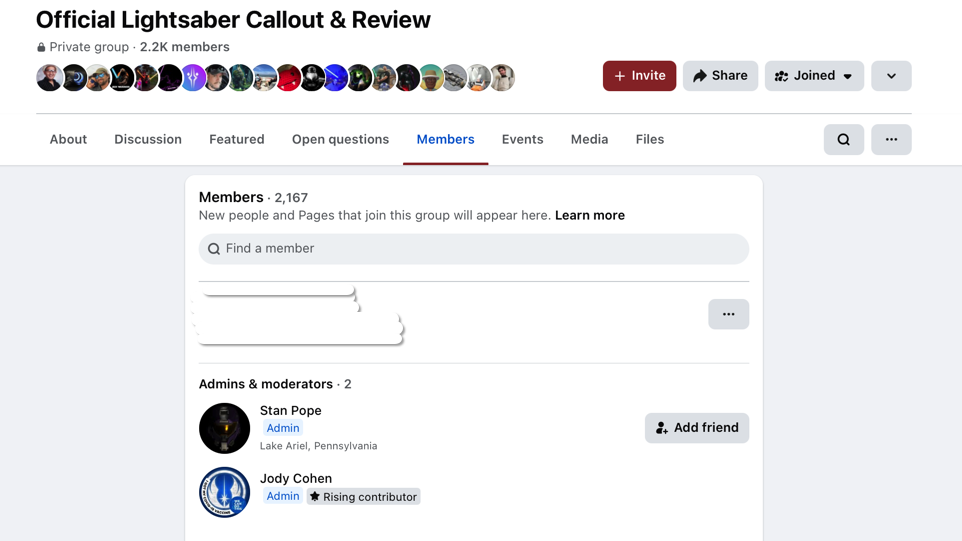
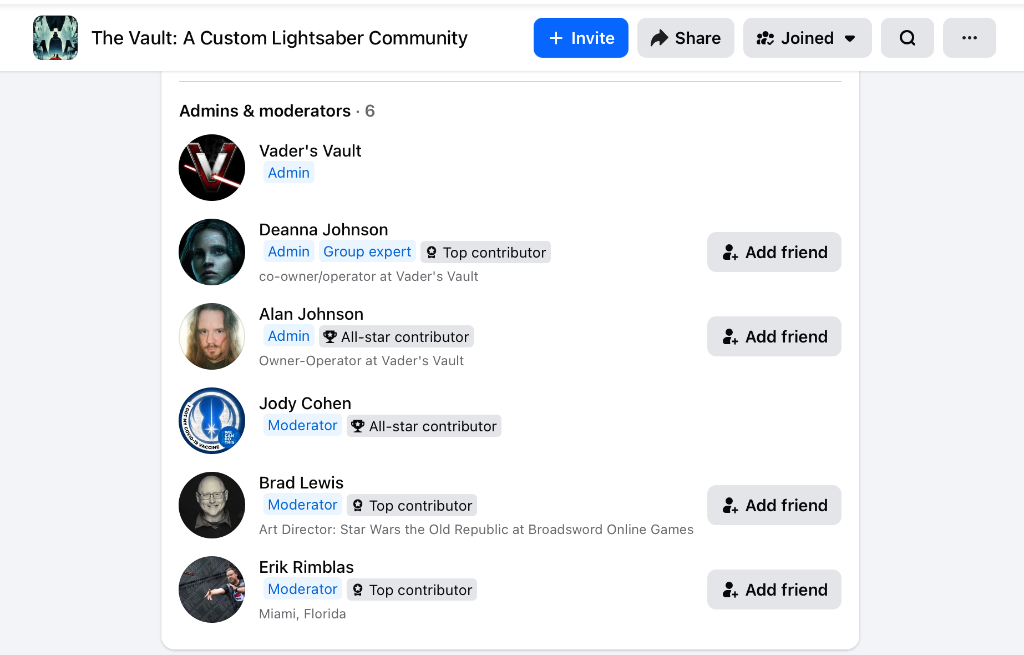
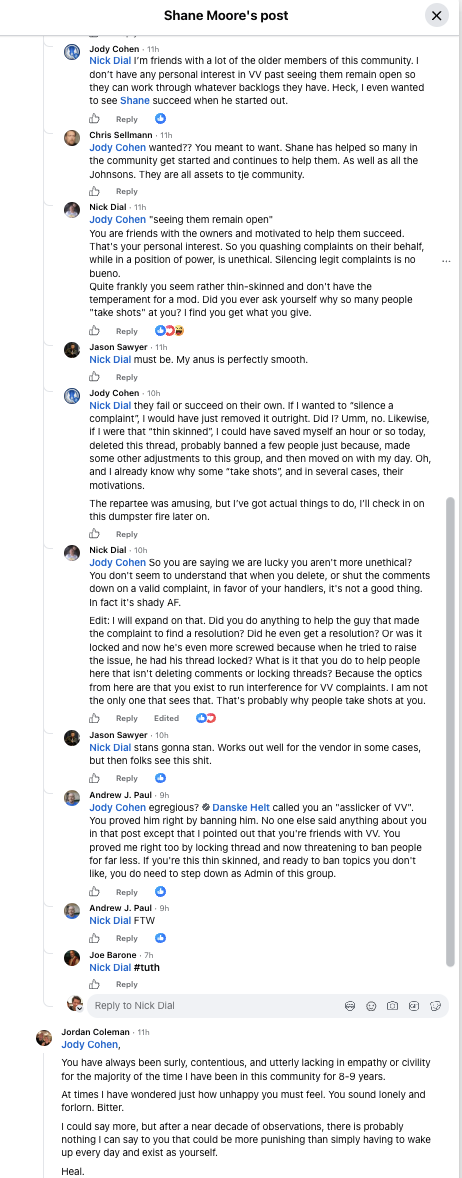
Shane Moore Post in Official Callout Group 23Aug26 on Jody Cohen's biased behavior
Facebook screenshots, 23 August 2026
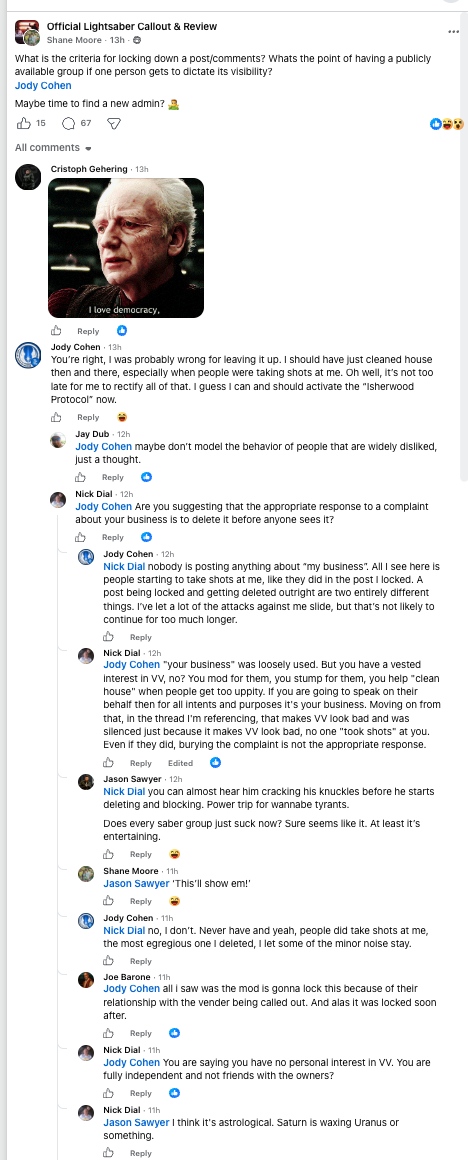
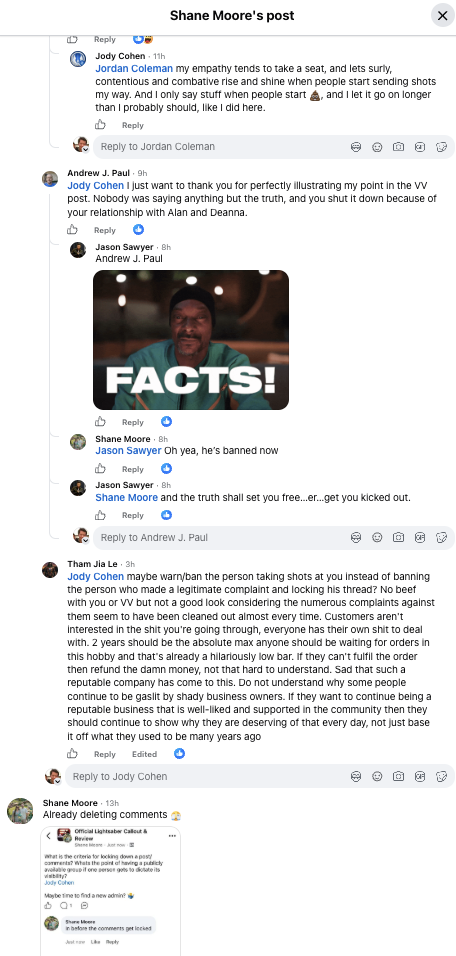
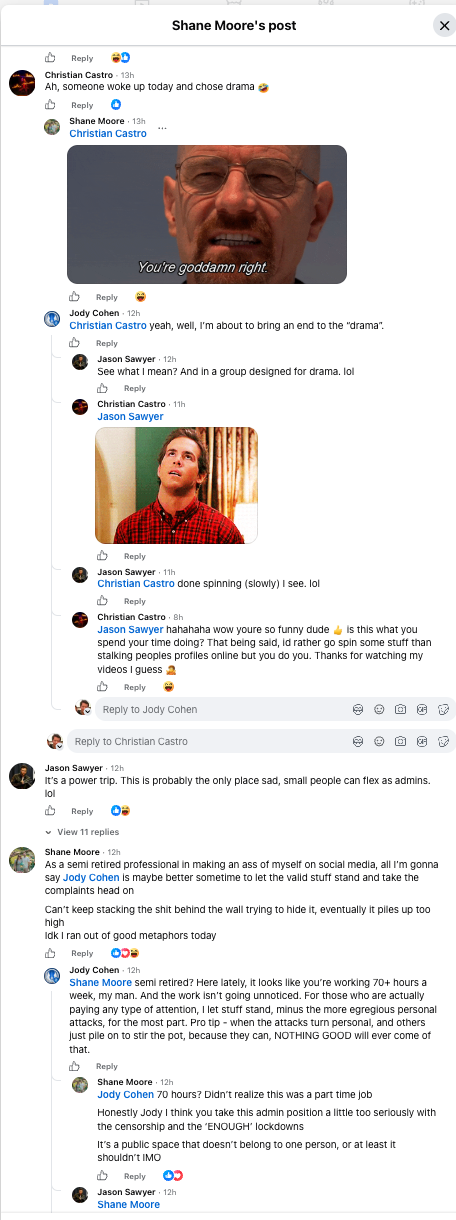
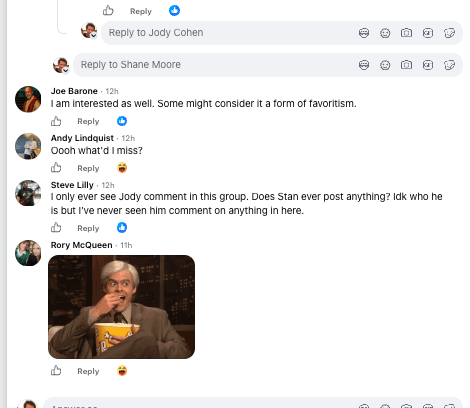
On 23 August 2026, Shane Moore posted publicly in the "Official Lightsaber Callout & Review" group — a group founded to "Call out scammers, liars, and whoever you want" — questioning the criteria for locking down posts and comments, and openly suggesting it was time to find a new admin: "Jody Cohen Maybe time to find a new admin? 🤦♂️"
The thread drew a chorus of members challenging Cohen's moderation ethics. Nick Dial laid out the conflict of interest plainly: "You are friends with the owners and motivated to help them succeed. That's your personal Interest. So you quashing complaints on their behalf, while in a position of power, is unethical." He pressed Cohen on whether the complainant whose thread was locked ever received a resolution, concluding: "the optics from here are that you exist to run interference for VV complaints."
Andrew J. Paul noted that the only thing he'd said was that Cohen is friends with VV — and that Cohen proved the point by locking the thread and threatening to ban people. (Andrew J. Paul was himself banned soon after). Jason Sawyer called it a "power trip," the only place "sad, small people can flex as admins." Jordan Coleman, after near a decade in the community, described Cohen as "surly, contentious, and utterly lacking in empathy or civility."
Cohen's own responses only reinforced the criticism — threatening to "activate the 'Isherwood Protocol'," boasting he could have deleted the thread and banned people "just because," and admitting he keeps VV complaints visible only because removing them outright would be too obvious. The thread is a live, on-the-record demonstration of the very conflict of interest this page documents: an admin of a "callout" group, personally allied with the brand being called out, silencing and threatening the very complaints the group was created to host.
How Impartial can the facebook group The Vault: A Lightsaber Community be?
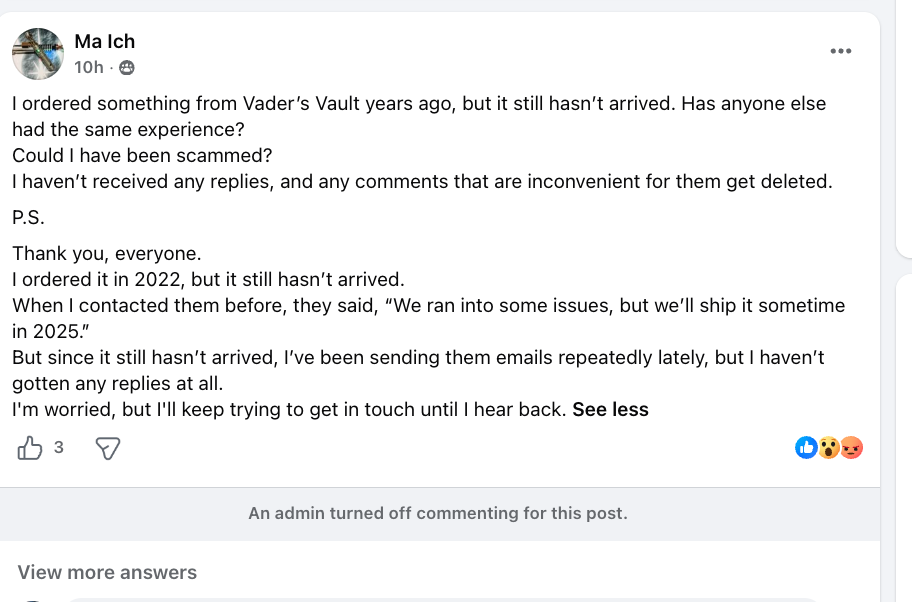
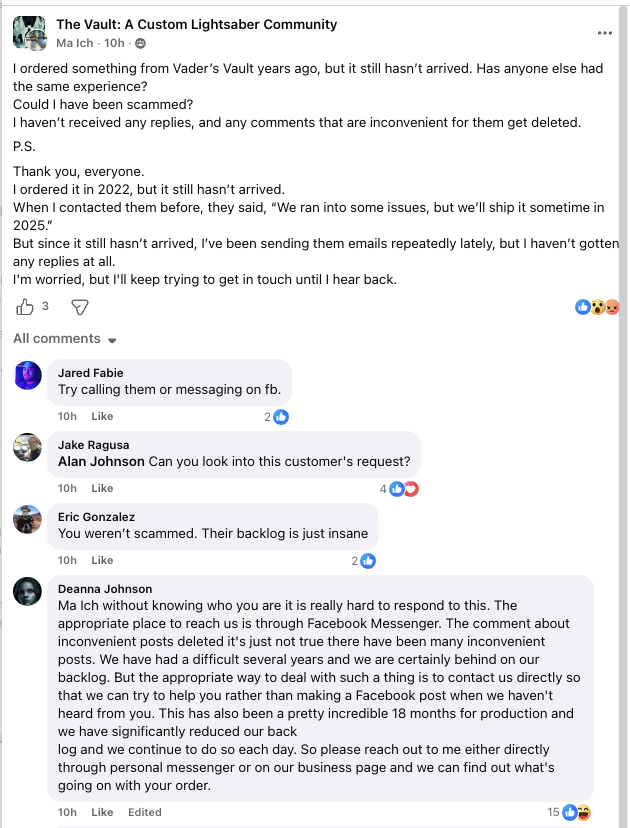
The following screenshots from "The Vault: A Custom Lightsaber Community" Facebook group — the very group whose admin list is stacked with Vader's Vault co-owners — illustrate the conflict of interest in action. A customer, "Ma Ich", posted that they ordered from Vader's Vault in 2022, were told it would ship "sometime in 2025," and still had received nothing. Repeated emails went unanswered, and the customer alleged that inconvenient comments were being deleted.
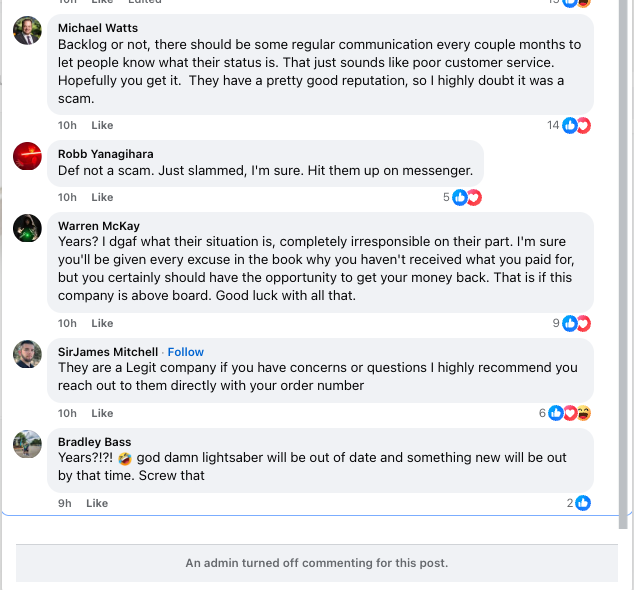
The community response was sharply polarised. Some members defended the company as "legit" but overwhelmed by backlog; others called the multi-year wait "completely irresponsible" and poor customer service. Deanna Johnson — a Vader's Vault co-owner and group admin — pinned a reply denying that inconvenient posts are deleted, attributing the delay to a "difficult several years," and directing the customer to contact her privately via Messenger rather than in the group. Shortly after, an admin turned off commenting for the post entirely — silencing further public discussion of a years-old non-delivery complaint against the very brand the admins represent.
This is the fox-guarding-the-henhouse dynamic made visible: the group billed as a neutral community hub is moderated by the vendor being complained about, the vendor-admin controls the narrative in-thread, and then public comment is shut off. A buyer researching Vader's Vault in the group they are steered to by Facebook's algorithm sees curated positivity, locked threads and a lack of clarity — not independent oversight. What is even more of note is this: Vader's Vault and their representatives have never ever maintained they are/were done with delivering all these outstanding orders - by now overdue four years and counting, with the delayed period now far exceeding the original 'difficult several years'
Evidence — Non-delivery complaint & admin response in The Vault group
Facebook screenshots, 11 July 2026
Feedback from the community: did China cause the Big Saber Companies to censor?
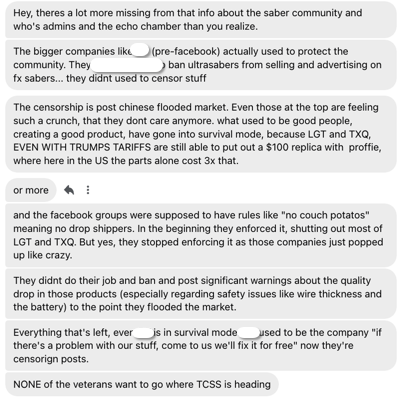
Unsolicited Facebook Messenger Msg from lightsaber community member — 11 April 2026
II. The Trap for New Buyers
Hobbyists Surreptitiously Morphing into Sellers, Traders, Installers & Makers
Besides misleading echo-chambering trapping new buyers, there's another phenomenon: you thought they were fellow hobbyists, and two turns later, you see that many have 'skin in the game'. Many individual, freelance, popping-up-all-of-a-sudden hobbyist/collector quietly turn into basic installers/customizers/MHS hilt makers/production run sellers/major sellers. They may not post boldly to announce their offerings, but instead watch all posts in the big groups and comment surreptitiously, to make offers and engage for self-promotion, before engaging you in a private conversation and eventually offering you what they have or plan to sell.
The Lightsaber Industry: No Standards
In stark contrast to other product marketplaces, the custom lightsaber community relies almost entirely on vendor-run Facebook groups. These groups operate without independent oversight, where negative reviews are swiftly deleted, and legitimate grievances are met with hostility from the vendor's loyal followers.
This environment mirrors the exact conditions the INFORM Consumers Act of 2023 was designed to combat—a lack of transparency that allows bad actors to operate with impunity. However, because these transactions occur informally via direct messages and external payment apps rather than through a platform's official checkout system, they legally bypass the Act's definition of an "online marketplace." Consequently, sellers evade the mandatory identity verification and financial disclosures required of high-volume vendors on platforms like eBay or Facebook Marketplace.
Furthermore, standard consumer protections evaporate in this informal setting. Facebook's own Purchase Protection explicitly excludes off-platform payments and group sales. While the Federal Trade Commission's Section 5 prohibits "unfair or deceptive acts," the agency lacks the practical mechanism to police thousands of decentralized, cross-jurisdictional peer-to-peer transactions. Buyers are left relying on PayPal's 180-day dispute window—which malicious installers frequently exploit by quoting lead times that intentionally outlast the protection period—or attempting costly civil litigation across state or international lines. In short, the legal architecture designed to protect e-commerce consumers simply does not apply to the way the lightsaber community currently conducts business.
Trust the OG? When Veteran Credentials Meet Actual Scrutiny
Lightsaber technology, parts and know-how are constantly improving - a fact that seems to consistently escape so-called 'veteran' practitioners as they take the role of couch-observers and call out active, ever-improving practitioners. One recent example is my first Martin Beyer Grandmaster Chassis acquisition from a 'veteran saber collector'. My installer, the outstanding Protosabers LLC reviewed it, and upon sighting Protosabers' review video, the seller immediately got his long time "OG" installer to comment with the following, via sound clips sent to me. I let this text, and (first two) before and (last two) after pics speak for themselves:




Before (top) & after (bottom) — Martin Beyer Chassis refreshed by Protosabers LLC
"I don't know how to put how I feel into words, to be completely honest. I'm watching the second video right now where he's talking about the parts, and he's talking about the things, and I don't know if you trust this guy, Shing, or I, like I said, I don't know what your guys' relationship is. But he doesn't seem to really know what he's doing. He, he's, I just, I watched him try and explain how the OLED is dead. The OLED's not dead. It's working perfect. It's fine. The OLED isn't bright, like an LED, or bright, like a neopixel, or something like that. It's not that bright. That's not how they work. And he's sitting here telling you that it's not working correctly, and it's dead, and it needs to be replaced."
— Seller's "OG" installer, via audio clips sent to Shing — proving just how convicted yet naive and utterly wrong a veteran of the saber industry can be.
III. Censorship, Rivalry, and Weaponised Status
When a buyer attempts to share a negative experience, they are rarely met with support. Instead, they face immediate and coordinated hostility. The accused seller mobilises their network — loyal customers, fellow builders, and sympathetic admins — to discredit the complainant.
This phenomenon is crippling to new hobbyists. After all, many sellers and installers and customizers cannot survive their own early fledgling success. Remember the classic failure cycle in a niche, hype-driven business:
Unsustainable Scaling: Riding a hype bubble without building sustainable capacity.
Financial Irresponsibility: Taking more money than the operation can responsibly fulfil.
Cash Flow Desperation: Prioritising new revenue over fulfilling old obligations.
Operational Collapse: Shortcutting quality to push products out while staff burn out.
Running Out the Clock: Relying on payment-platform time limits to expire.
Damage Control: Managing narratives instead of fixing problems.
The Censorship Playbook
In the "Lightsaber Market" Facebook group, a user posted a question asking why posts criticising Vader's Vault were being deleted. Multiple members pointed to the admin list, noting that Vader's Vault co-owners were admins. One member observed:
"This platform empowers censorship. I have never in my life seen so much of it... Don't be shocked when this post and all of these comments get tossed into the shadow realm."
The prediction was accurate. The original poster was shadow-banned simply for asking the question, and the offending post was deleted.
Similar toxicity plagues the Universal Lightsaber Community. Members have been banned for recommending one installer over another. As one user noted, it frequently becomes "the place to post your offensive pictures of someone you don't like," while independent sellers report being targeted by ULC admins.
The Industry Discourages Accountability
Perhaps the most insidious element is how fellow industry participants — installers, manufacturers, customizers — actively discourage victims from seeking justice.
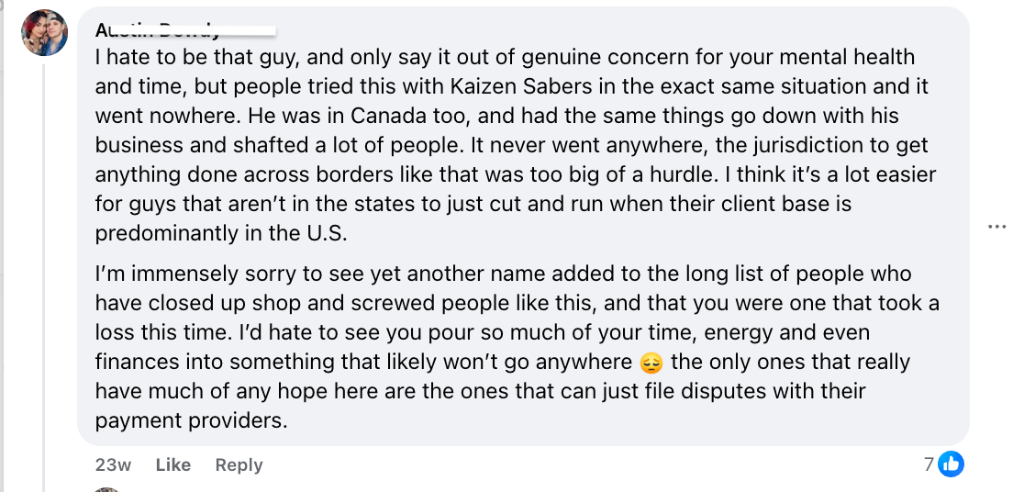
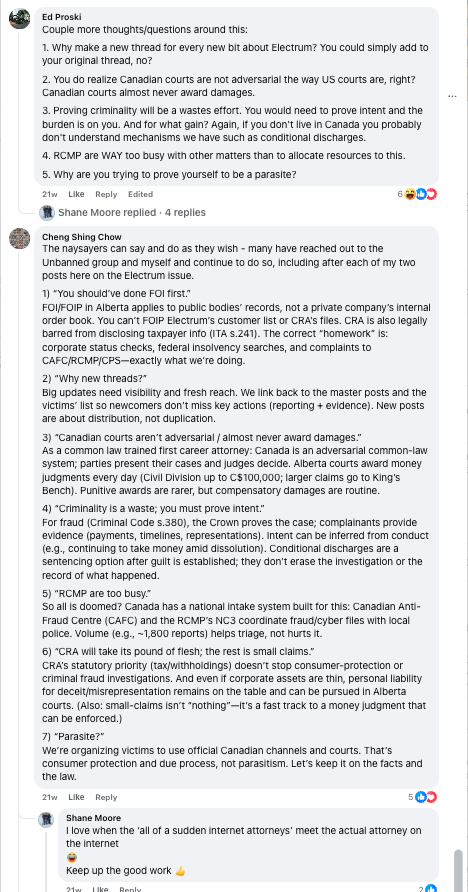
When customers of defunct companies attempt to organise legal action, other builders flood posts with defeatist rhetoric. They argue that courts won't award damages, that police are too busy, or that jurisdiction hurdles are too high. In one recent exchange, an established installer even called a victim a "parasite" simply for organising a consumer protection effort through official legal channels.
What is most revealing is who delivers this defeatist rhetoric: the people arguing against pursuing justice are invariably industry insiders themselves.
This is not helpful advice; it is an industry protecting its own. By discouraging collective action, the community ensures that bad actors can "cut and run" without consequence, leaving the financial burden entirely on the consumer.
Evidence — Industry Discourages Accountability
Screenshots showing defeatist rhetoric from industry insiders
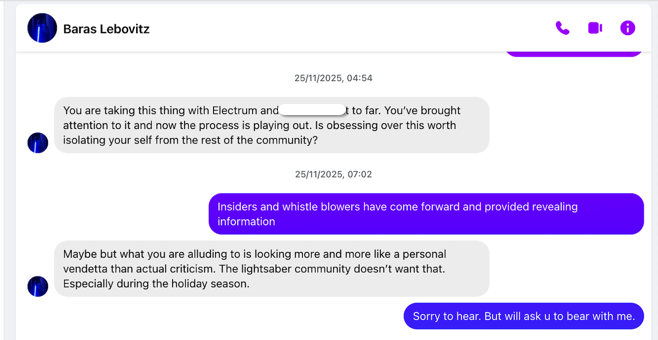
Of note:
Baras Lebovitz: messaged me to tell me to stop my actions against Electrum and publishing the whistle-blower account, because 'it was the holiday season.'
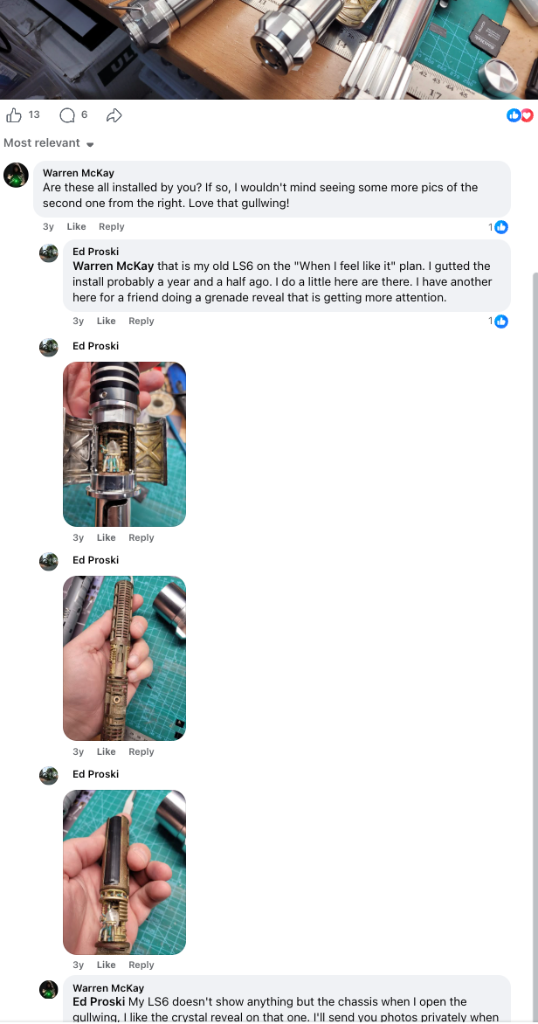
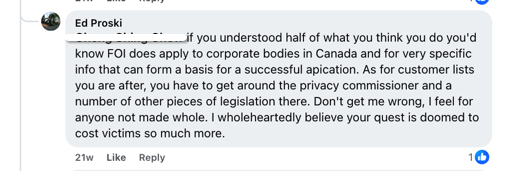
Ed Proski: vehemently railed against any action being taken, stating 'it was doomed to cost victims so much more.' But a CIU filing costs nothing — except time and effort to organise documents, proof, and chronology (I had already paid for the registry documents extraction and shared it with any victims who requested). No big surprise he is a Canadian installer living off the industry (Electrum is a Canadian company).
Conclusion: Evolve or Collapse
The lightsaber community has settled into a stable equilibrium where every participant's rational self-interest aligns with maintaining the status quo. Sellers benefit from suppressed criticism. Admins benefit from harmony. Yet this equilibrium is a slow death spiral for the industry itself.
It is incomprehensible that high-end lightsabers fail to capture the massive economic tailwind of "kidulting" — adults driving growth in toy and collectible markets. According to recent Circana data, global toy sales grew 7% last year entirely due to adult spending, with adults now accounting for more than double the market share they held a decade ago.
These are consumers with disposable income happy to splurge year-round on collectibles that provide "wow and wonder," such as the $1,000 Lego Star Wars Death Star. Star Wars toys dominate the kidult market. Yet the custom lightsaber industry — the ultimate high-end Star Wars collectible — remains excluded, largely because its toxic, insular culture actively repels the very demographic currently propping up the global toy industry.
For Survival, Restructure
For the custom lightsaber industry to survive and tap into this booming market, it must fundamentally restructure:
-
Independent Platforms: Establish independent platforms for reviews and transactions where administrators have zero financial stake. Vendor-run groups must be treated as corporate marketing, not neutral community hubs.
-
Standardised Consumer Protection: Adopt standard retail practices including transparent lead times, escrow payments, and clear refund policies aligned with credit card and PayPal buyer-protection windows.
-
Persistent Information: Create a centralised, searchable, permanent database of vendor reviews and histories, preventing bad actors from simply changing their name or waiting for the feed to scroll past their failures.
Until consumer protection is prioritised over vendor reputation and the cycle of manipulation is broken, the honest collector will continue to pay the price. And the industry will continue to shrink, locked out of a booming market by its own refusal to professionalise.
[1] The Economist. (2026, Feb 5). Adults are propping up the toy industry: In praise of lifelong joy. Business | Kidults.